
This international investigation into solar power plants and agricultural land in Bosnia and Herzegovina and North Macedonia was conducted over several months by journalists Dejan Rakita and Aleksandar Manasiev.
Authors: Dejan Rakita and Aleksandar Manasiev
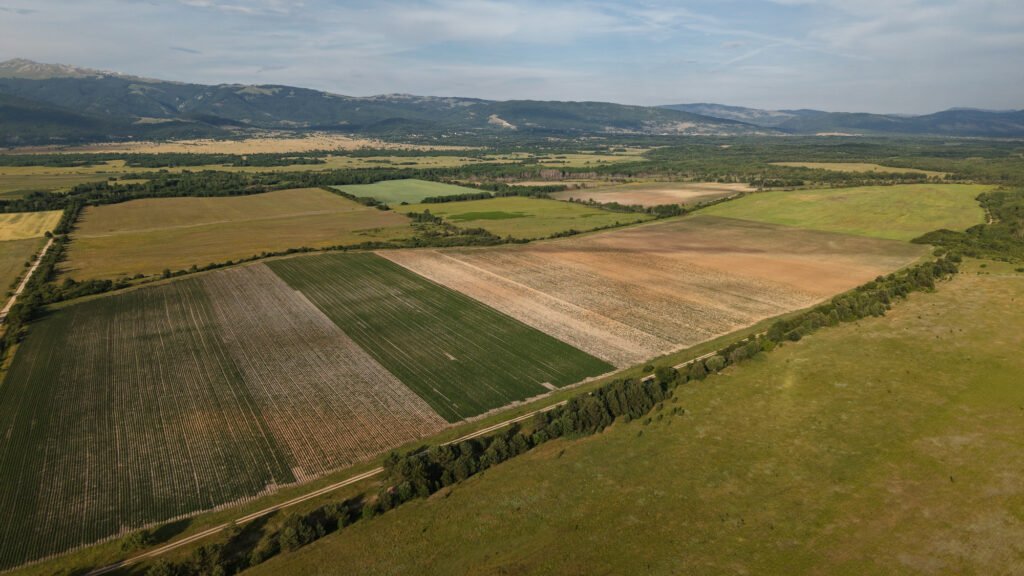
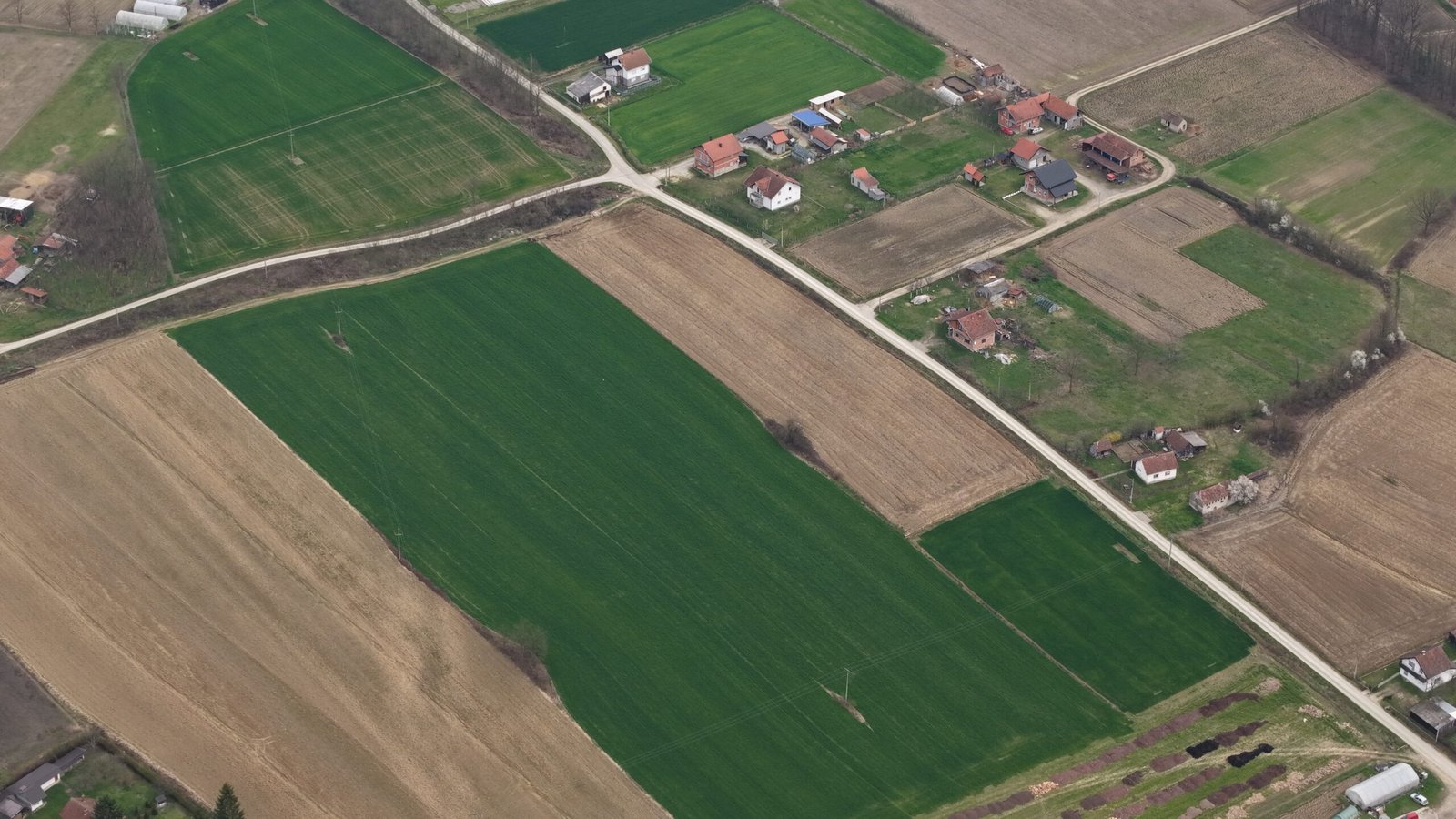
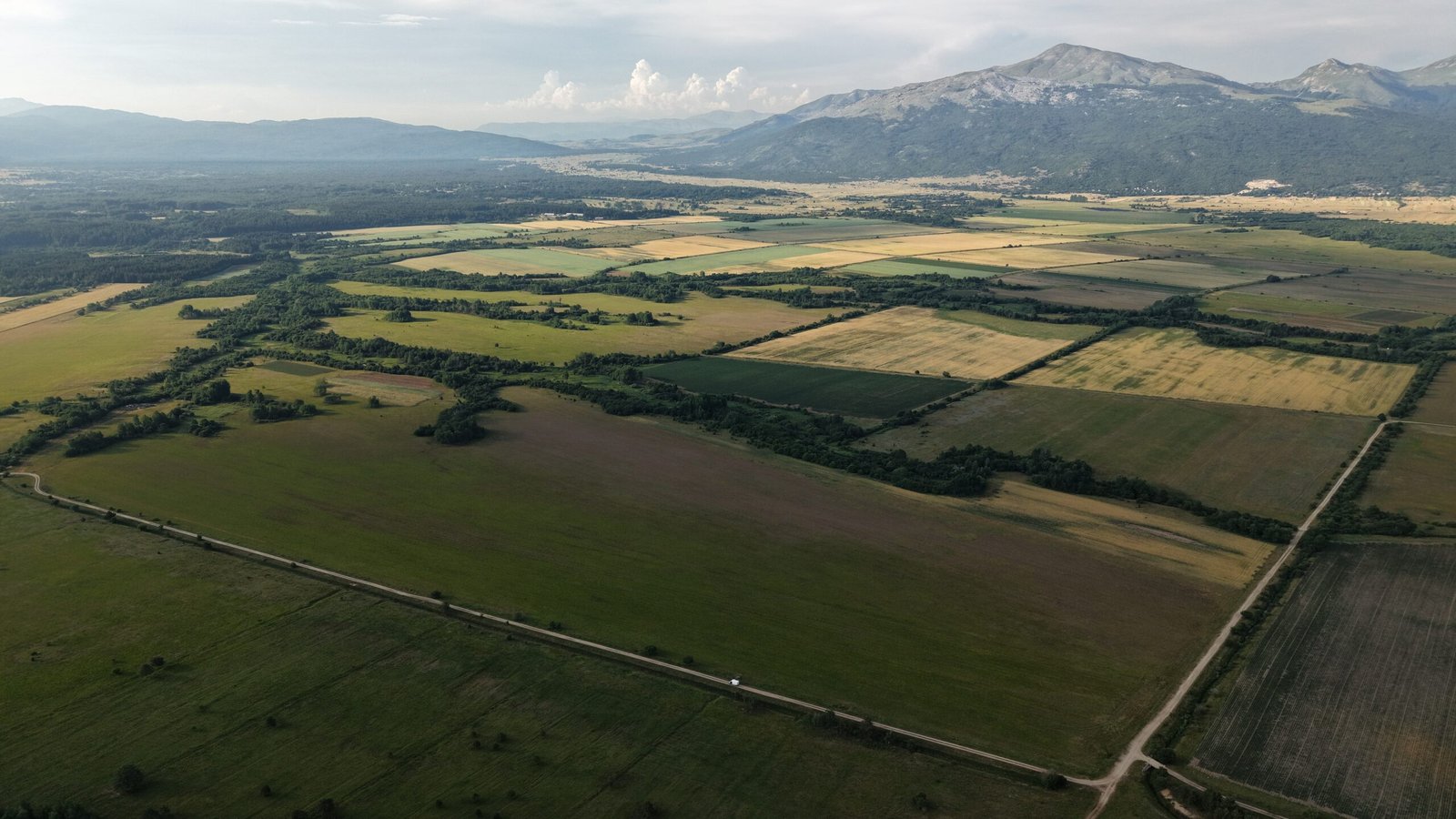
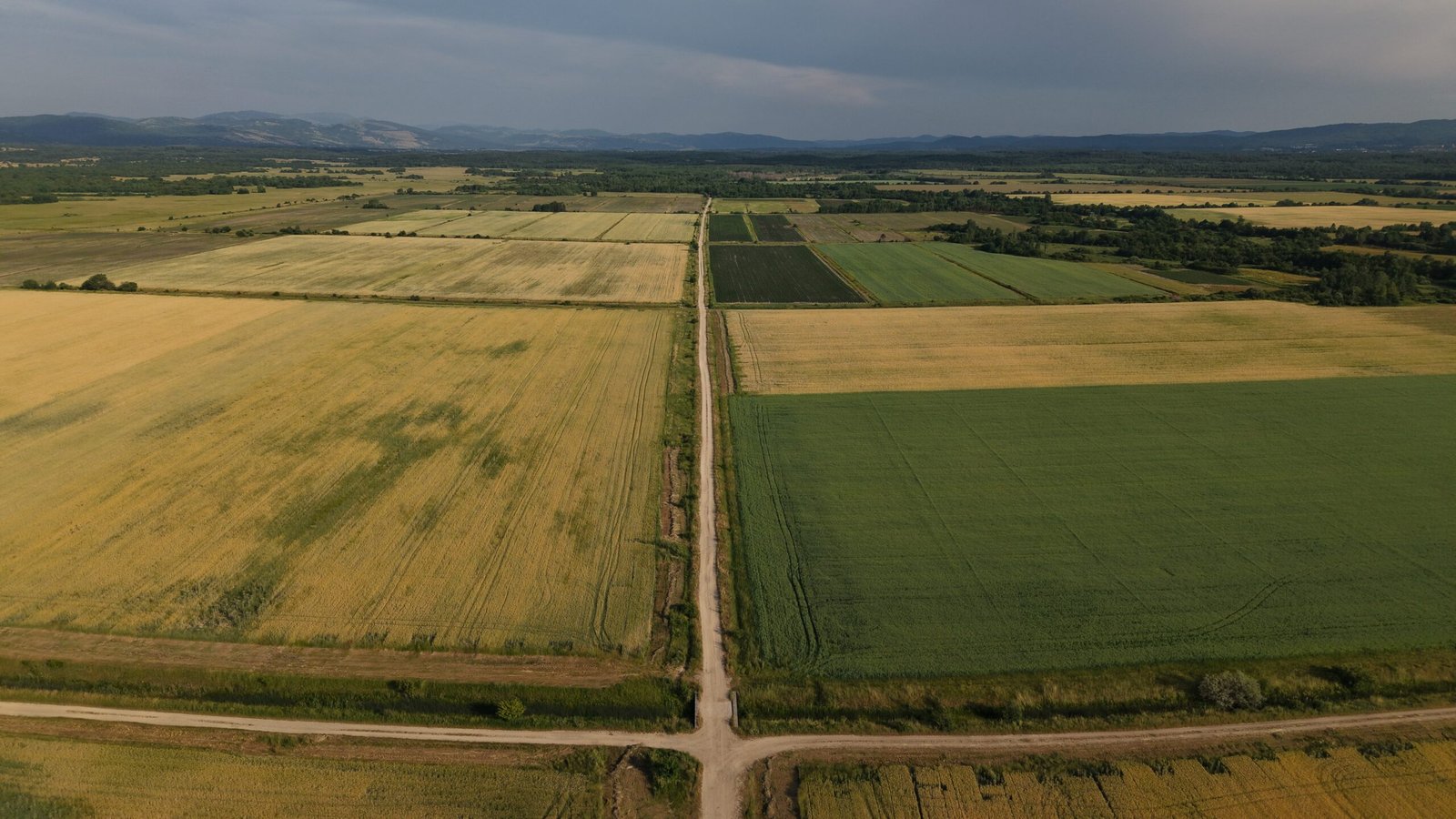
Nevesinjsko Polje is a broad plain in eastern Herzegovina, east of Mostar in Bosnia and Herzegovina. Its arable land stretches between the Velež and Crvanj mountains.
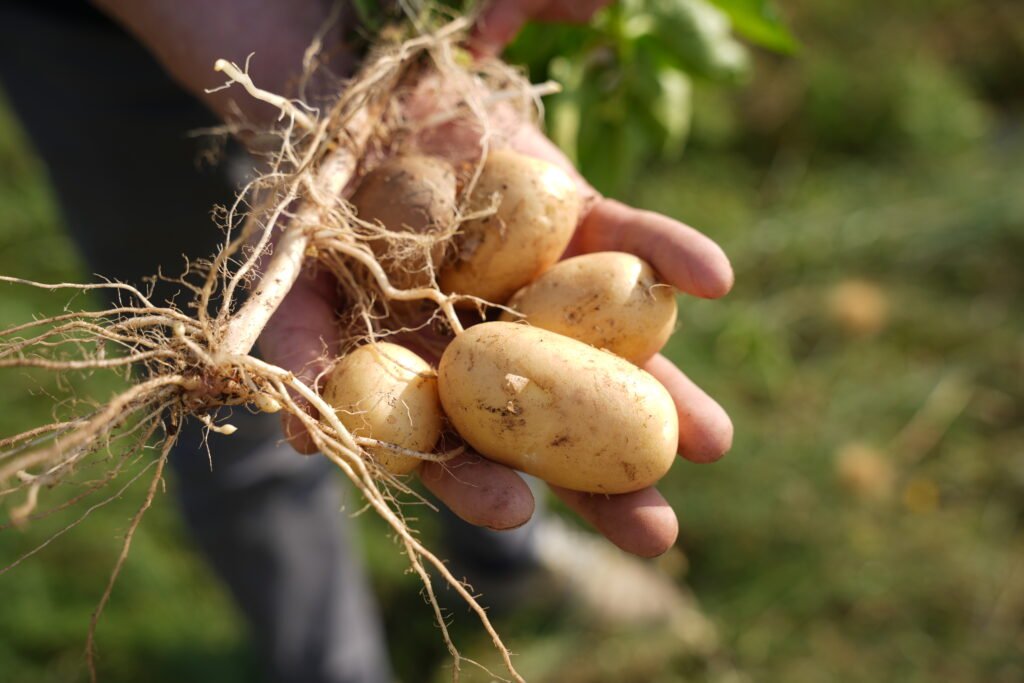
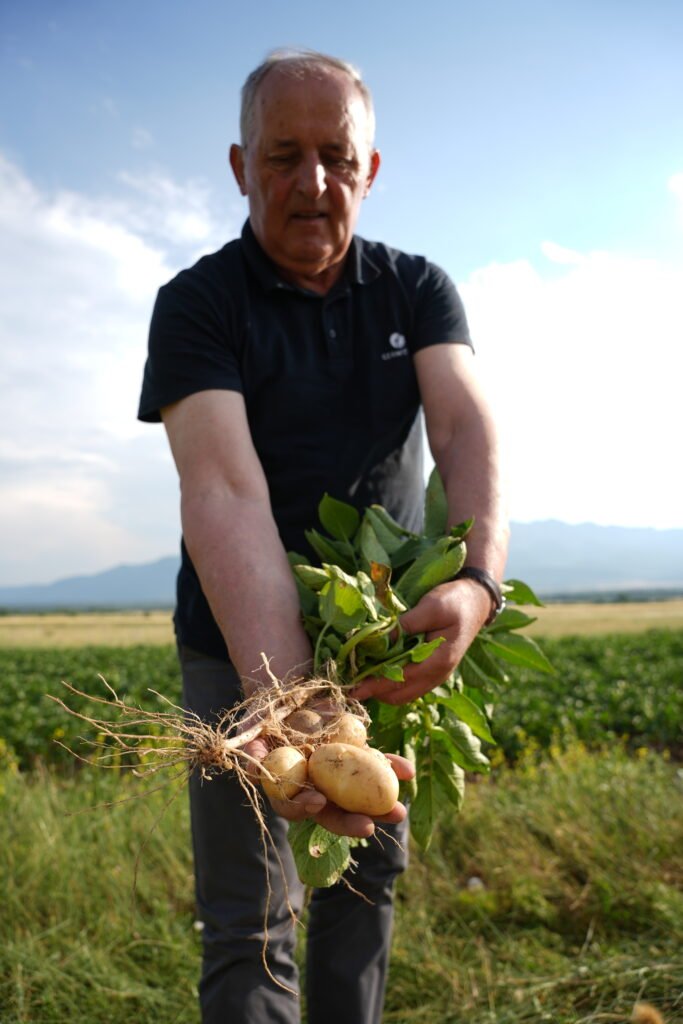
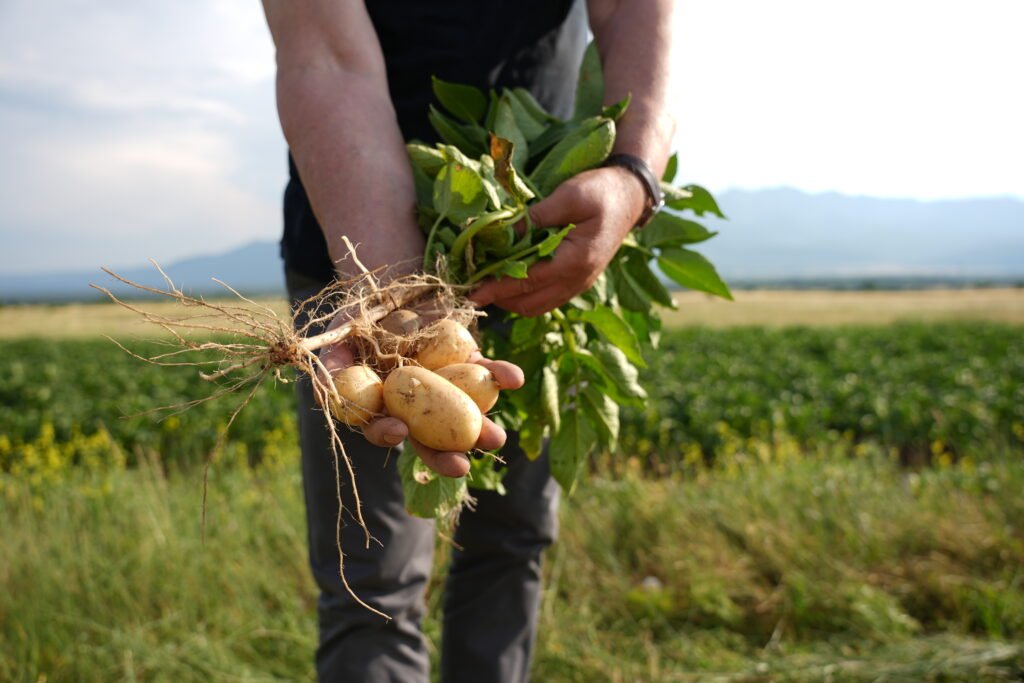
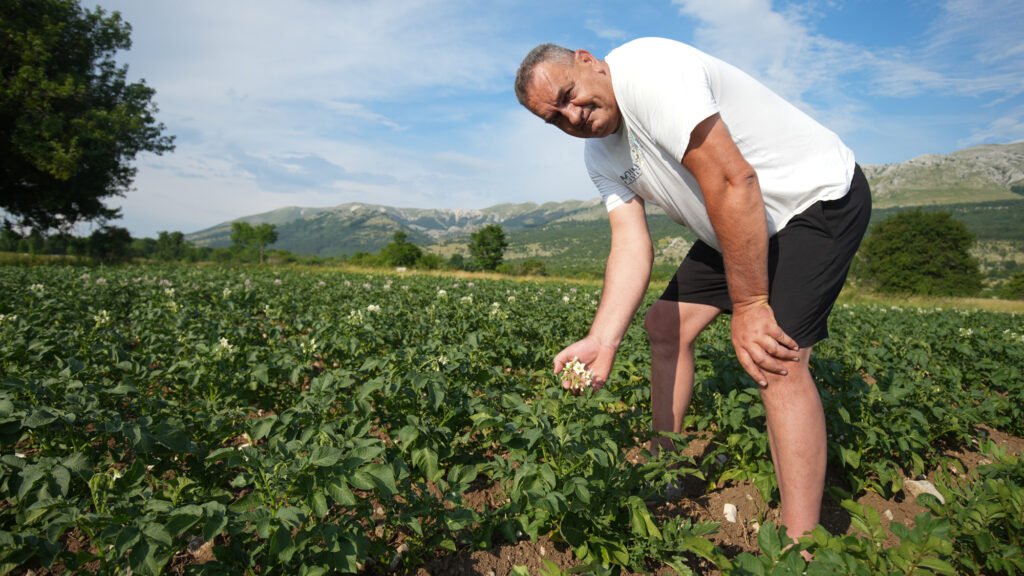
In Pridvorci, local farmer Veso Radić points to rows of potatoes. When we visited him, there was also a trial plot of new varieties, meant to show which of them grow best in this part of Herzegovina. On other plots, his family grows cereals, onions and other crops. They also raise livestock, keeping cows and producing milk.
For Radić, this land is therefore neither scenery nor real estate waiting for a more profitable use. It is the foundation of the whole family farm. That year alone, he had around 3.5 hectares of potatoes and more than five hectares of cereals, on plots scattered for kilometres across the plain.
The Nevesinje potato is more than a local brand. In 2020, the Food Safety Agency of Bosnia and Herzegovina registered it as a product with a protected geographical indication, because its qualities are linked to the local soil, altitude and climate.
That is why Radić struggles to accept what is happening. Farmers are being told about developing domestic food production, while large areas of land around Nevesinje, and across Herzegovina, are turning up in plans for solar power plants.
“You cannot imagine that we cannot get that land on lease to cultivate it, land that has irrigation, while they want to give it over to solar plants. It is not a small area. Around 1,100 hectares of agricultural land were involved,” he says.
He lists sites around Nevesinje: Zlatac, Kovačice, Gorica and other large areas that once belonged to agricultural enterprises. Part of Zlatac, he says, even has irrigation infrastructure. The land was once used by Agrohercegovina and, before it, by Hepok, a former Yugoslav agricultural giant. Other areas were used to grow potatoes and cereals, or held orchards and livestock farming.
Agronomist Mate Majić was monitoring the trial of new potato varieties. He believes the area has significant potential for food and seed production. Speaking in Radić’s field, he describes the soil and climate as highly favourable for agriculture. He also warns that the security of food production will become ever more important.
“It is extremely important that we create conditions for younger generations to stay in these areas and make a decent living from agricultural production,” Majić says. “The importance of agricultural land should not be neglected in any respect. Everything else can be made up for, but a shortage of food becomes a serious problem.”
While Radić sees this land in terms of hectares and the food they can produce, energy documents measure Nevesinje in a different unit: megawatts.
NOSBiH’s current Indicative Generation Development Plan lists a group of projects called “SE Nevesinje”, with a total capacity of 570 megawatts, among the country’s largest solar projects.
This is where the wider problem begins. Bosnia and Herzegovina needs more energy from renewable sources to reduce its dependence on coal and on emissions from thermal power plants, and to meet its decarbonisation commitments. But the question of where to produce that energy has remained far less regulated than the drive to build new megawatts as fast as possible.
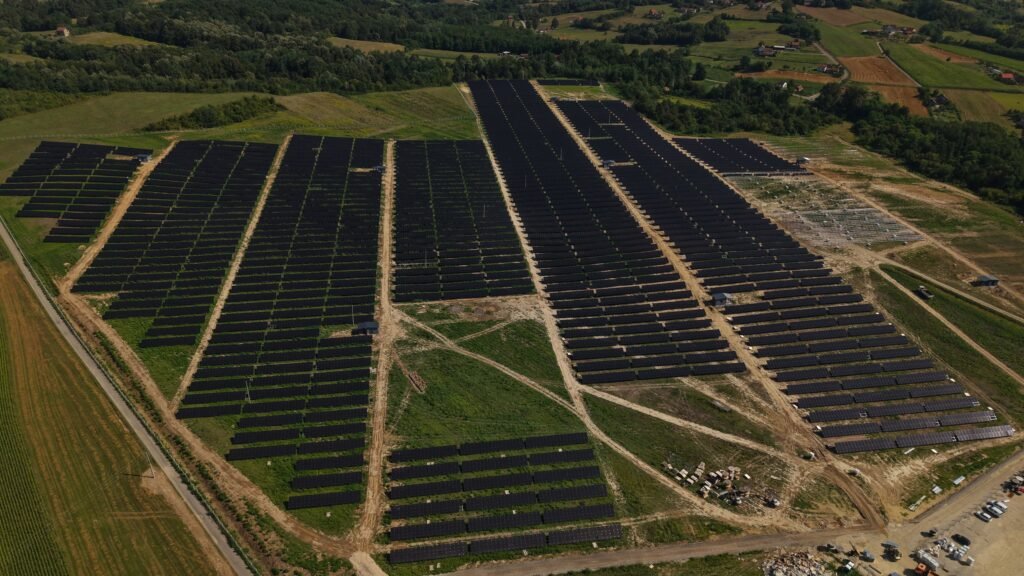
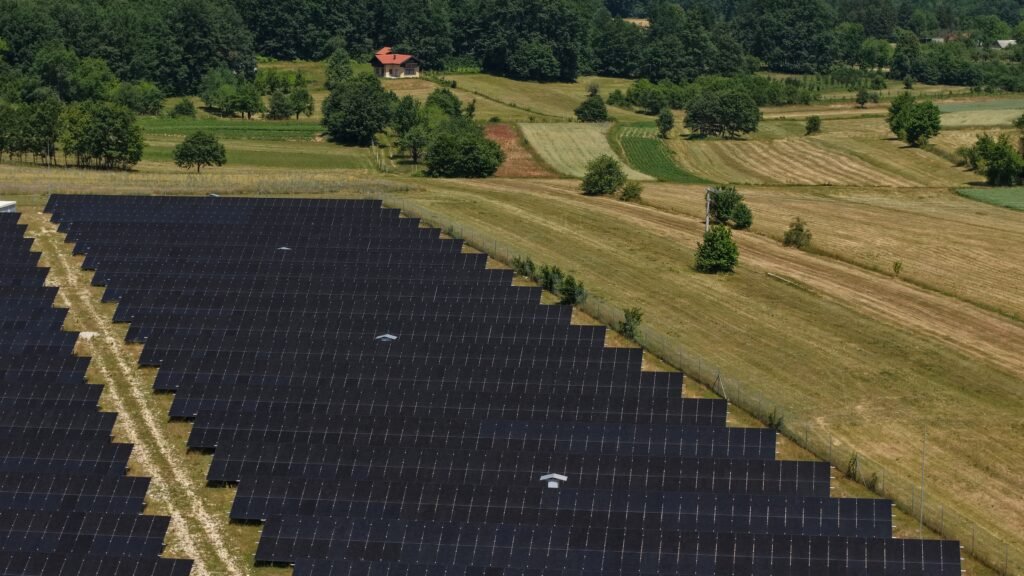
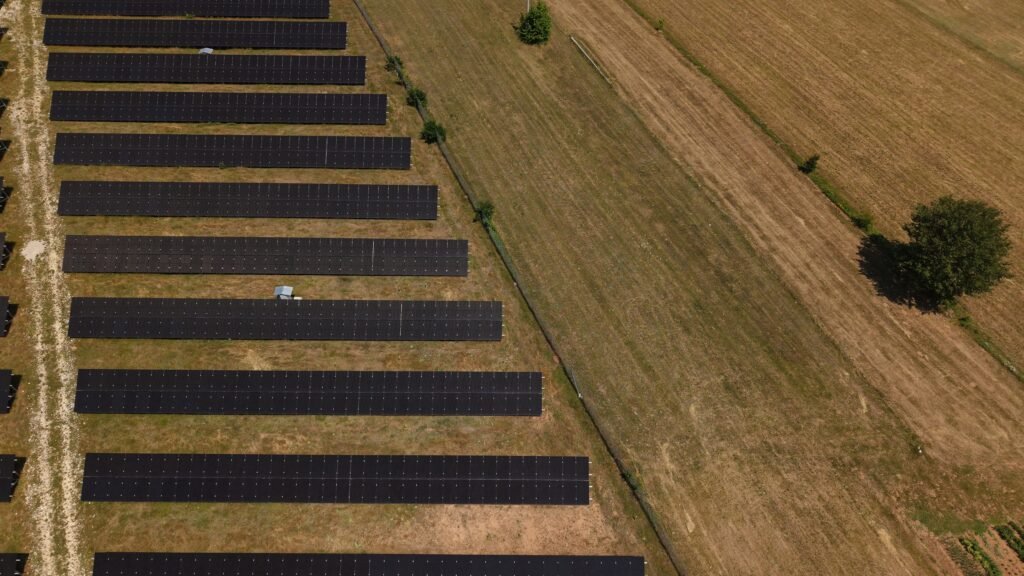
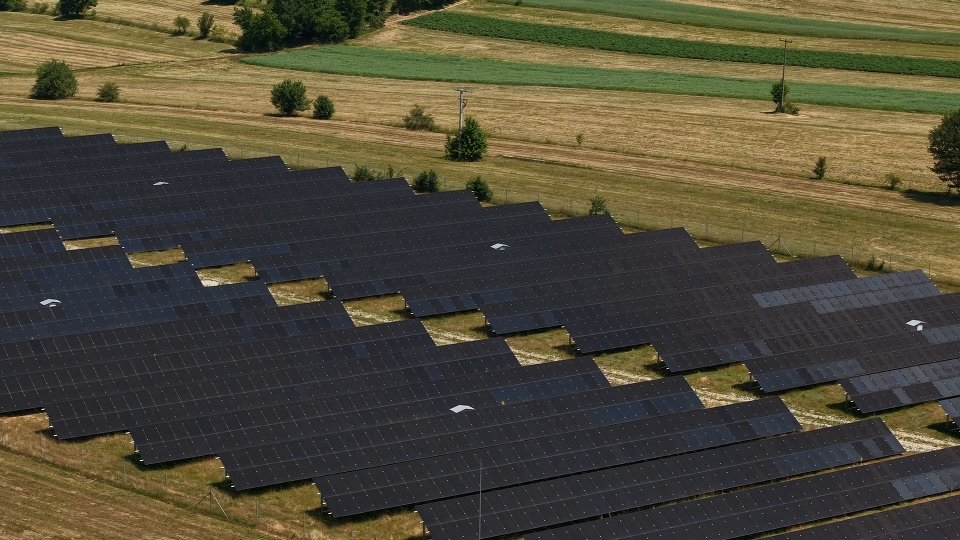
As solar generation grows rapidly, solar projects are increasingly occupying agricultural land. Republika Srpska is one of the country’s two entities, alongside the Federation of Bosnia and Herzegovina. There, 3,064 hectares of agricultural land were converted to other uses in just three years. Solar panels ended up on more than 60 per cent of that area.
At the same time, key energy plans have yet to be adopted. Investors initiate the choice of sites for large power plants. And the authorities are only now trying to tighten rules that allowed dozens of small installations to be built side by side.
The question of where to build also links these fields with another Western Balkan country, North Macedonia: its land market, its permitting system and its changing protections for agricultural land. The evidence differs. In Republika Srpska, it comes from local disputes and land-conversion figures. In North Macedonia, it comes from audit findings and gaps in institutional records.
3,064 hectares of farmland lost in three years
Solar energy in Bosnia and Herzegovina has grown exceptionally fast in recent years. Although it was the last of the main renewable sources to enter large-scale construction, it is now growing the fastest. By the end of 2025, the total installed capacity of solar power plants had reached around 914 MW. During that year they produced around 1,156 GWh of electricity, roughly 8 per cent of the country’s total output. That already makes solar the second-largest renewable source of electricity in Bosnia and Herzegovina, behind hydropower and ahead of wind.
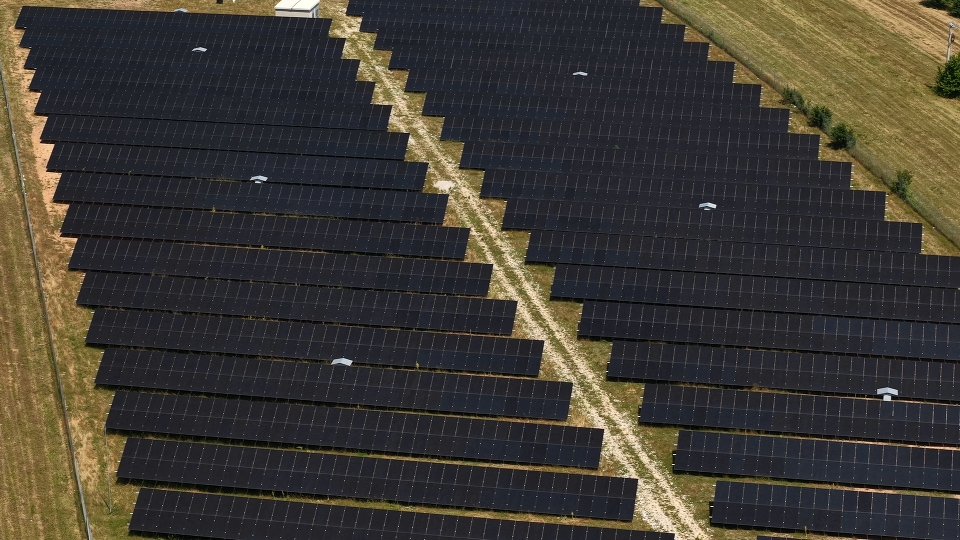
On paper, the numbers are far larger. In its Indicative Plan for 2027–2036, NOSBiH says the register of grid connection applications contains around 13,500 MW of photovoltaic projects and approximately 4,600 MW of wind power plants.
That does not mean 18,100 MW of new power plants will actually be built. The projects are at different stages, from early investment intentions to far more thoroughly prepared projects.
But the pressure on land can already be measured.
Data from Republika Srpska’s Ministry of Agriculture, Forestry and Water Management show that conversion is accelerating year on year. In 2022, 588 hectares were taken out of agricultural use; in 2023, around 1,141 hectares; and in 2024, as many as 1,335 hectares. In just two years, the annual volume of conversion more than doubled. Data for 2025 have not yet been published.
Minister Anđelka Kuzmić, speaking for this investigation, says energy and food production should not compete with each other.
“Energy and food are equally important for the whole world, but one must not come at the expense of the other,” Kuzmić says. “At the end of last year, through a report covering the whole of Republika Srpska, we saw an expansion of solar panels, and that is why we sent letters to all local authorities asking them to review cases and strictly comply with the law. We also appealed to the Inspectorate, because we must protect our villages and agricultural land.”
The warning, however, came only after thousands of hectares of agricultural land had already been converted.
Fields for sale as solar sites
Over the past decade, online classifieds in North Macedonia have been full of offers selling agricultural land as sites for electricity generation. In one ad for two neighbouring fields in Staro Nagoričane, the seller says the land is suitable for growing crops and has a borehole, but could also be used for photovoltaic plants. Another ad, for land in Tarinci, asks ten euros per square metre. According to the seller, the plot has already been zoned for solar power plants, and the building permit procedure can begin immediately.
These are just some of the many offers in which farming and energy appear in the same ad. But behind every possible sale lies a decision with far longer-term consequences: which land will keep producing food, and which will be turned over to electricity generation.
In June 2026, North Macedonia tightened protection for higher-quality agricultural land. Yet the Ministry of Energy, Mining and Mineral Resources admits it has no detailed data on which registered photovoltaic plants were built on agricultural land. State auditors, meanwhile, found unlawfully issued approvals, inconsistent records and shortcomings in oversight.
“Practice so far shows that the protection of fertile land is not sufficiently integrated into planning the energy transition,” says Elena Nikolovska, climate programme coordinator at the organisation Eko-svest.
For her, developing solar energy is essential, but site selection must take account of food production, nature and climate risks. Fertile land, she points out, becomes even more important in a country vulnerable to droughts and other climate extremes.
Solar energy in North Macedonia is booming. According to the Energy Regulatory Commission, there were 222 photovoltaic plants in 2021 and 1,458 in 2025: more than six times as many in just four years. The biggest jump came in 2023, when the number grew by 527.
Professor Dejan Trajkovski links the growing interest in photovoltaic projects to the energy crisis and favourable climatic conditions. Investors, he says, are also buying or leasing fertile land, including areas in Pelagonia.
“Interest is focused on flat, easily accessible fields. Increasingly, we are witnessing the conversion of land that until yesterday produced cereals,” Trajkovski says. He believes priority should be given to degraded land, mountain slopes, ravines and former mines.
At the same time, the area of agricultural land is shrinking. According to the State Statistical Office, total agricultural area fell by 30,056 hectares, or 2.38 per cent, between 2014 and 2025. Cultivated land, which is part of the total agricultural area, decreased by 7,101 hectares over the same period.
Measured from 2019, the decline in cultivated land is even sharper. That year there were 519,848 hectares of it; by 2025 the area had fallen to 504,478 hectares, a drop of 15,370 hectares. The largest annual decrease in both categories was recorded in 2024.
These figures show the general trend. They do not establish how much of the loss of agricultural land should be attributed to photovoltaic plants.
“Cultivable agricultural land is a finite natural resource that takes centuries to form, and once it is lost or permanently degraded, it cannot be replaced,” warns Dragi Dimitrievski, a professor and expert in agricultural economics.
Conversion, he explains, reduces the potential for domestic food production and increases dependence on imports. In his view, the consequences are also felt by rural areas whose income and development depend on agriculture, as well as by water resources and biodiversity.
The concern is not only about land taken out of food production. Trajkovski also warns of the consequences of heavy machinery and of setting the mounting posts in concrete. Nikolovska points out that construction can compact the soil, damage its structure and alter the water regime.
Can the land be farmed again later?
“Reuse is possible in certain cases, but it is not automatically guaranteed and depends on how construction and maintenance are carried out,” Nikolovska says.
What the Macedonian experts describe is part of a wider debate about where to build. In Podnovlje near Doboj, that debate has already become a dispute over the land on which a solar complex is being built.
More than 100 small plants on one field near Doboj, and a dispute that drags on
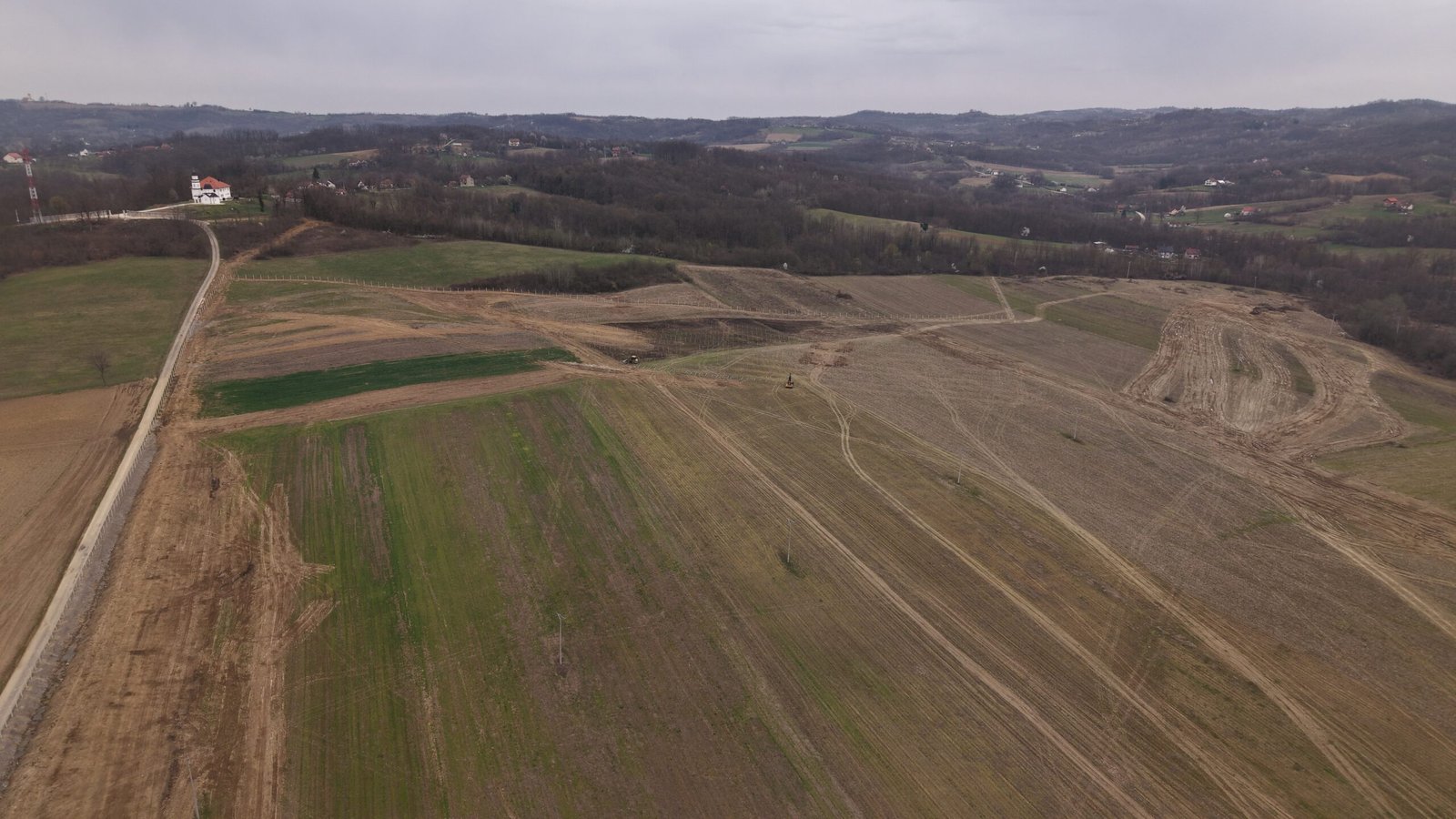
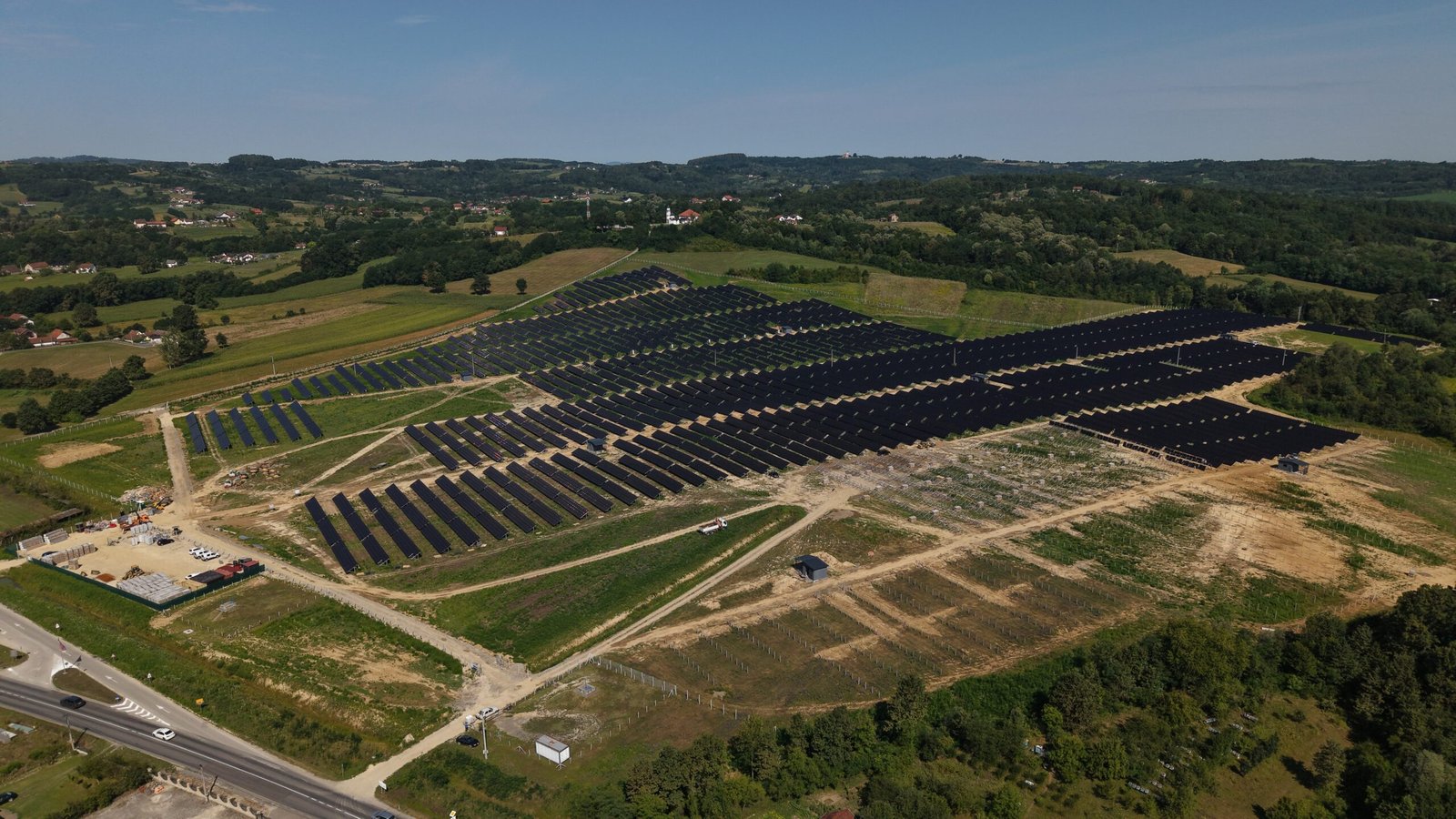
While Nevesinje is still arguing over the sites of planned solar plants and the use of agricultural land, in Podnovlje near Doboj, at the other end of Bosnia and Herzegovina, the consequences can already be seen on the ground.
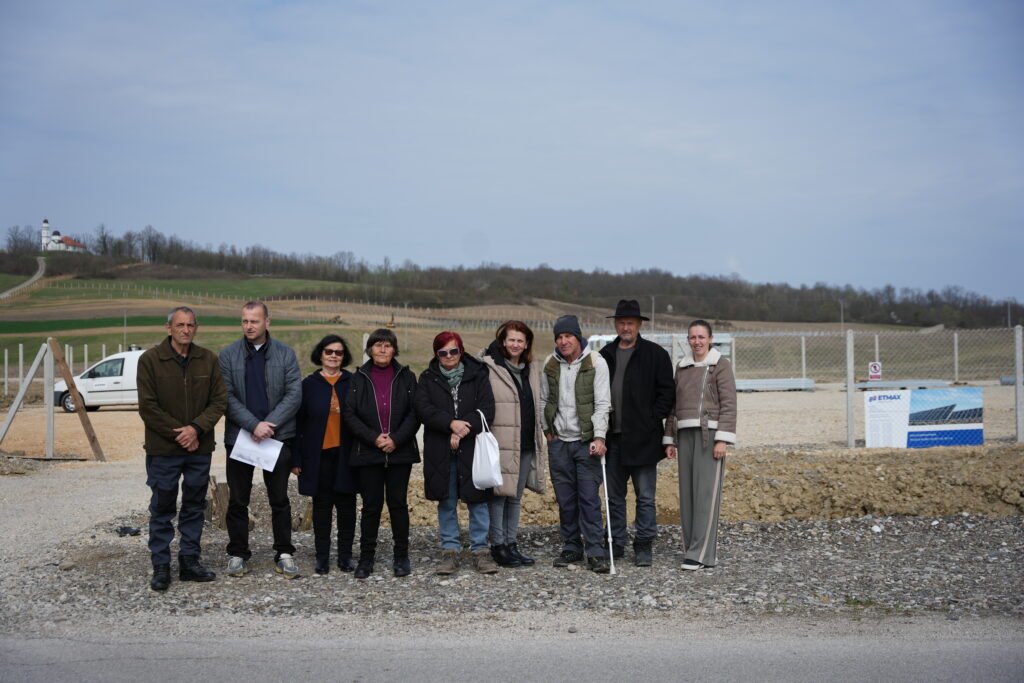
At Crkveno Brdo, more than a hundred small solar power plants have gone up on around 28.5 hectares of former agricultural and cooperative land. Initial information referred to 92 installations. Documentation later showed that the City of Doboj had issued at least 104 building permits, though that number is most likely not final.
Residents began protesting on 12 March 2026. They did not dispute the need for renewable energy, but their first concern was the fertile land.
According to their accounts, maize, wheat, barley, vegetables and other crops had been grown there for years. For decades, the land was registered as held by the Podnovlje Agricultural Cooperative, a local farming organisation that brings producers together and jointly manages or uses land for agricultural production. Parts of the land that the cooperative did not farm itself were made available to local producers. The City of Doboj later registered the land in its own name and sold it to the company ETMAX, which the cooperative is contesting in court.
Milorad Blagojević lives literally next to the newly built solar complex and has kept bees on the same spot for more than three decades. He points to the land now covered by mounting structures for solar panels and recalls a different picture.
“Yes, this is agricultural land. The cooperative used to rent the land to farmers; they paid and ploughed it,” Blagojević says. “There was maize and wheat here, and people used them to feed livestock and for their own needs. The land is very good quality. I’ve seen maize and wheat here, and people say everything used to grow, strawberries and other things too.”
Their second concern was ownership: how the land passed from cooperative property to the City of Doboj, and then into the hands of a private investor.
After numerous protests, complaints and proceedings, on 2 April 2026 the Supreme Court of Republika Srpska finally overturned an earlier decision by the District Court in Doboj in the proceedings over the registration of the land, and sent the case back for a new decision. The judgment did not automatically return the land to the cooperative, nor did it order the works to stop. But it reopened the legal status of land on which the power plants were already being built.
And here something remarkable happened: instead of winding down, the works actually sped up, to the disbelief of Podnovlje’s residents.
They had not been stopped earlier either, when the city’s environmental inspectorate found that the investor lacked the required environmental permits and ordered it to obtain them.
During months of protests, police came to the site several times. Some residents told us that their public opposition to the project had exposed them to direct or indirect pressure, and that some people had withdrawn from the protests out of fear for their jobs or other livelihoods. The number of people at the protests did decline over time, while a smaller group kept pressing the institutions to act.
Ana Đukić is among those who have not given up, even as she fights her own battle for her health. She travels to nearby Banja Luka for radiotherapy, and when she returns to Podnovlje she works to alert the public, through protests, posts on social media and statements to the media.
She says residents wrote to ministries, inspectorates and local authorities, but for a long time could not get even basic explanations.
“We are trying to reach any institution at all. We sent letters to five ministries, but nobody contacted us even to hear our problems,” Đukić says. “We went individually to the inspectorates in Doboj, and nobody wanted to come and explain to us what was going on. A person cannot give up on fighting for their rights. We will keep gathering, even if there are only two of us.”
ETMAX, the company carrying out the project, did not answer any of our repeated questions about the land, the permits, the continuation of works and the connection of the plants. Nor did the City of Doboj, although many of the questions concerned precisely the city administration’s decisions, building permits and handling of the land.
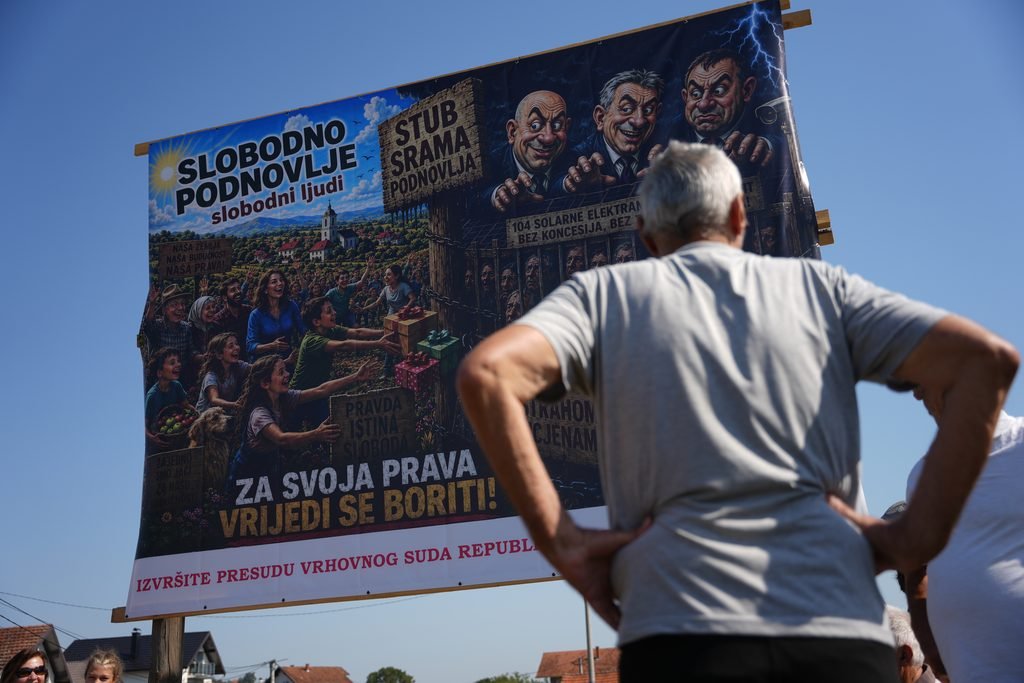
With no answers to their letters either, residents and activists from Restart put up a billboard beside the main road. It read: “Who is trampling on the Supreme Court of Republika Srpska?”
The first billboard was removed overnight in late July. Two weeks later, residents put up a new one with the same question. Some residents were then summoned to the police for informative interviews, and police also went to look at the billboard itself.
In August, the District Public Prosecutor’s Office in Doboj confirmed that two cases had been opened: one concerning the billboard, the other concerning the disputed land and the construction of the solar plants. The prosecutor’s office also confirmed it was acting on a criminal complaint by the Podnovlje Agricultural Cooperative over suspected abuse of office in the transfer of title and subsequent sale of the land.
The solar complex did not wait for the outcome of those proceedings. In October, Elektro Doboj, assisted by a large number of police officers, began laying a medium-voltage connection for the plants. Police later confirmed that it was Elektro Doboj, not ETMAX, that had requested their assistance. During the works, a pipe in the local water system was damaged, and residents prevented digging on part of the land they say is private property. The works then continued along the road corridor.
Only in early November, as this article was being completed, did the prosecutor’s office begin taking statements from some of the residents who had opposed the project for months. Residents are still unsure whether this is a form of pressure on them to give up protesting and accept that the solar project is there to stay in their village, or whether the institutions have finally started doing their job.
Podnovlje has thus reached a paradoxical point. Legal proceedings over the land are still under way, and the prosecutor’s office is only beginning to question residents in more detail. Yet the power plants are almost finished, and the infrastructure to connect them is already being laid.
The 150-kilowatt threshold, “abused in practice”
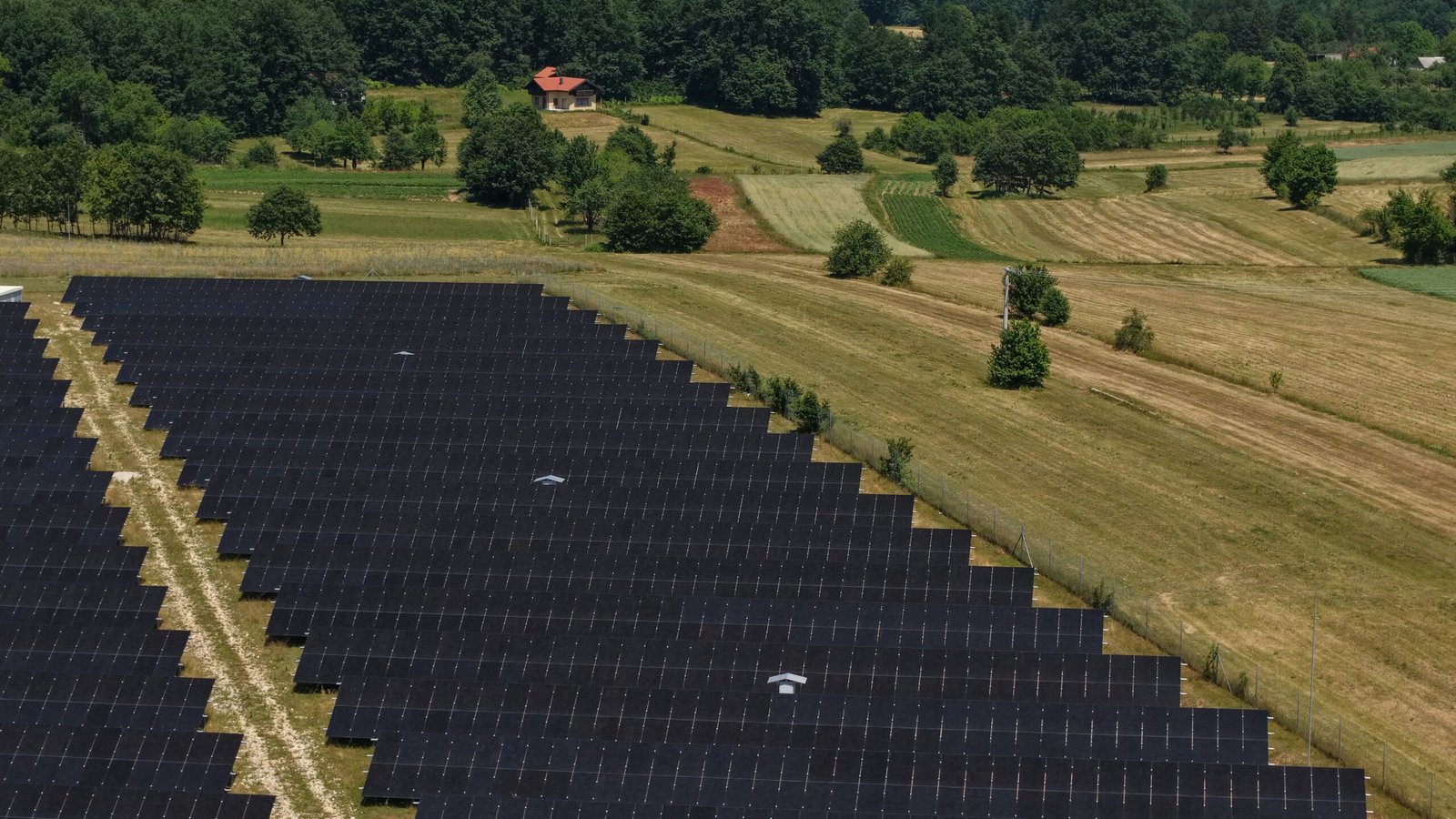
Podnovlje also stands out because more than a hundred plants were designed as a series of individual low-capacity installations, even though they sit side by side and form what is almost a single solar complex.
In June 2025, the Regulatory Commission for Energy of Republika Srpska (RERS) announced that ETMAX had applied for preliminary entitlement to incentives for 35 small solar power plants in Podnovlje. Most of them had exactly the same installed capacity: 147.06 kW.
A capacity of 147.06 kW sits just below the 150 kW threshold that matters for incentives. Ground-mounted solar plants of up to 150 kW can, if they meet the prescribed conditions and quota is available, obtain the right to guaranteed purchase of the electricity they produce for up to 15 years.
The second important threshold is 250 kW. Under Republika Srpska’s Law on Concessions, ground-mounted solar plants need a concession only when their installed capacity exceeds that limit. A concession is a right granted by a public authority to an investor to build and use an energy facility under certain conditions, with contractual obligations and payment of a concession fee.
This means a 147.06 kW installation stays below both thresholds at once: it does not need a concession, and it can apply to the incentive scheme.
Incentives, however, are not automatic. In May 2026, RERS announced that the quantities of energy earmarked for incentives up to 2030 had already been allocated, and that new applications for which no quota remained would be rejected.
It is precisely this model that the Government of Republika Srpska has itself recognised as problematic.
The explanatory memorandum to the 2026 draft amendments to the Law on Renewable Energy Sources states that the existing provision has been “abused in practice”. The government describes cases in which large areas of land were divided into smaller plots, on which groups of 20 to 50 small solar plants of up to 150 kW were then built.
Such installations stay below the concession threshold and therefore pay no concession fee, which for projects under concession is public revenue. At the same time, if they meet the prescribed conditions, they can obtain guaranteed purchase of their electricity for up to 15 years.
The draft therefore proposes mandatory spacing between such plants and an end to the possibility of reserving incentives before a plant has actually been built.
In its basic features, the solar project in Podnovlje closely resembles the pattern the government describes: more than a hundred small plants built at one site, many of them designed with a capacity just below 150 kW. So far, however, no court or regulator has found that the Podnovlje project was unlawfully divided to avoid a concession or to obtain incentives.
Missing records, unlawfully issued approvals
How much land in North Macedonia has been converted for solar power plants? The Ministry of Energy, Mining and Mineral Resources could not answer.
The ministry says it has no detailed data on whether the plants from the period covered by our request were built on agricultural land. Nor does it have data on the specific cadastral plots, land use or soil-quality class.
“These data fall within the remit of other institutions that maintain the relevant records,” the ministry replied.
Building energy facilities on land that previously had another use, it explains, requires a land-use conversion procedure. Depending on the project, several institutions take part in approvals, among them the ministries of transport, agriculture and environment, the Energy Regulatory Commission and municipalities.
Trajkovski believes that public consultations and presentations do not give farmers and local residents timely and substantive information.
“Citizens usually react only when they see the excavators in the fields themselves, when it is already too late to react,” he says.
The energy regulator’s records cannot fill that gap either.
“Electricity generation licences are issued after the power plant has been put into operation,” the Energy Regulatory Commission states. Licence obligations, it explains, concern the rules for operating on the electricity market, not deadlines for construction or for starting operation. In other words, a list of licences alone cannot reconstruct how a field became a power plant.
The Ministry of Agriculture, Forestry and Water Economy also acknowledges problems with records. Its draft regulatory impact assessment for the new law on agricultural land cites “fragmented and partly inconsistent records and registers”, limited monitoring and control, land degradation and pressure to convert land to construction use.
The same assessment notes that there is no single alphanumeric and graphic register. Incomplete and outdated data, the ministry concludes, limit the scope for sound policymaking.
The audit of renewable energy permits shows how serious the consequences of poorly coordinated institutional action can be. The State Audit Office found that between 2022 and May 2025, the system failed to ensure full compliance with the law and efficient implementation of procedures. By May 2025, no Indicative Plan for the Construction of Renewable Energy Capacities had been adopted, although it was supposed to serve as the basis for planning new power plants and their grid connection.
In Štip, auditors found that the municipality had issued approvals for three photovoltaic plants of 19, 174 and 337 megawatts. These were facilities of national significance, for which the Ministry of Transport and the government should have been responsible.
“Construction of three ground-mounted photovoltaic power plants was unlawfully approved,” the audit report states.
The records do not match either. In 2025, the register contained 525 producers of photovoltaic electricity, while Energy Regulatory Commission data showed that 1,040 producers held a temporary or permanent licence. Auditors link the gap to weaknesses in coordination, in updating data and in enforcing the registration requirement.
These findings concern permits and oversight. On their own, they do not establish how many fertile fields were converted, nor do they prove the previous land class of each individual project. But they show that institutions did not maintain consistent records or systematically control the sector’s development.
In Republika Srpska, a different kind of record offers another view of the problem: cadastral proceedings show how agricultural plots acquire a different administrative status.
How a field changes status on paper
Behind every solar project lies another layer that is hard to see on the ground: the cadastral land-use category, the land class and spatial plans.
Under Republika Srpska’s Law on Agricultural Land, land in cadastral or soil-quality classes I, II, III and IV may be converted in accordance with implementing spatial planning documents. Where no such document exists, the options for changing land use are far more limited. The law also prohibits changing a plot’s cadastral land-use category and class for non-agricultural purposes before the land-conversion procedure has been lawfully completed.
That is why data from RUGIPP, Republika Srpska’s administration for geodetic and property affairs, are particularly important to the solar story.
In Avtovac near Gacko, six applications to change the land-use category and class of land were submitted during 2026. According to RUGIPP’s response, the applicants are individuals, the private owners of the plots. For one of the applications, agricultural consent to convert agricultural land into construction land had already been submitted, while the other proceedings were still under way.
Avtovac resident Desko Mastilović says the land in question had been farmed for years.
“So this is agricultural land, arable, a field of the third and fourth class,” Mastilović says.
According to what he knows, the applications to change the class and land-use category were submitted by the owners of the plots where construction of solar plants had begun, as well as by some owners of neighbouring plots.
Similar proceedings were conducted in Nevesinje. In the cadastral municipality of Miljevac, legal entities submitted three applications to change the land-use category and class. Two applications from 2025 were rejected on the basis of decisions by the Ministry of Agriculture, while the third, submitted in 2026, was approved and the change entered in the records.
In Podnovlje near Doboj, RUGIPP conducted several proceedings at the request of legal entities during 2024, 2025 and 2026. In two cases, the recorded use of the plots was changed to solar power plants on the basis of building permits.
On the ground, a field may look the same as it did in previous decades. But its future use is often decided through administrative procedures: agricultural consents, spatial plans, building permits and, finally, changes in the cadastral records.
North Macedonia bans solar on better farmland, with exceptions
In June 2026, North Macedonia’s parliament amended the Law on Agricultural Land. Article 49 now explicitly prohibits converting agricultural land in cadastral classes I, II, III and IV for the construction of photovoltaic power plants. The ban also applies to privately owned land.
But there is an exception. The amendments include a transitional provision. Procedures initiated through applications submitted via the e-Urbanism system, or through requests for opinions on urban plans and projects, will be completed under the old rules if their planning or project programme was approved before the law entered into force. The new ban therefore does not halt all previously initiated procedures.
Professor Dejan Trajkovski believes that the protection of agricultural land is weakened by legal “loopholes” in conversion procedures through urban plans for areas outside settlements. In his view, formal assessments do not always reflect the real quality of the land.
“Assessments are often made in offices, on paper, without proper visits to the site to see the real quality of the soil. That is precisely why we end up with absurd situations in which fields that were fertile until yesterday become construction zones for energy overnight,” Trajkovski says.
“The need for stricter restrictions shows that the mechanisms used so far have not provided sufficient protection,” Nikolovska says.
Legal restrictions alone, she warns, will not be enough without clear criteria for site selection, transparent procedures and effective oversight. She places responsibility with the institutions in charge of energy, agriculture, spatial planning, the environment and local government. She also calls for accountability for the failures identified and for the auditors’ recommendations to be implemented.
Meanwhile, the Ministry of Agriculture has prepared a draft of a new, broader law on agricultural land. It too proposes restricting photovoltaic plants on class I–IV land, but with an exception: public-interest facilities established by law or a strategic document, where the state is the dominant owner and investor. The new framework would thus leave room to convert higher-quality land for certain state projects.
Laws set the limits. But in Nevesinje and Gacko, the disputes are also about something else: how much say residents actually have in decisions.
5,800 signatures, and the solar projects are still there
Veso Radić, whom we met at the start of this story, says he learned of the scale of the solar plans for Nevesinjsko Polje from the media, not from local or Republika Srpska institutions.
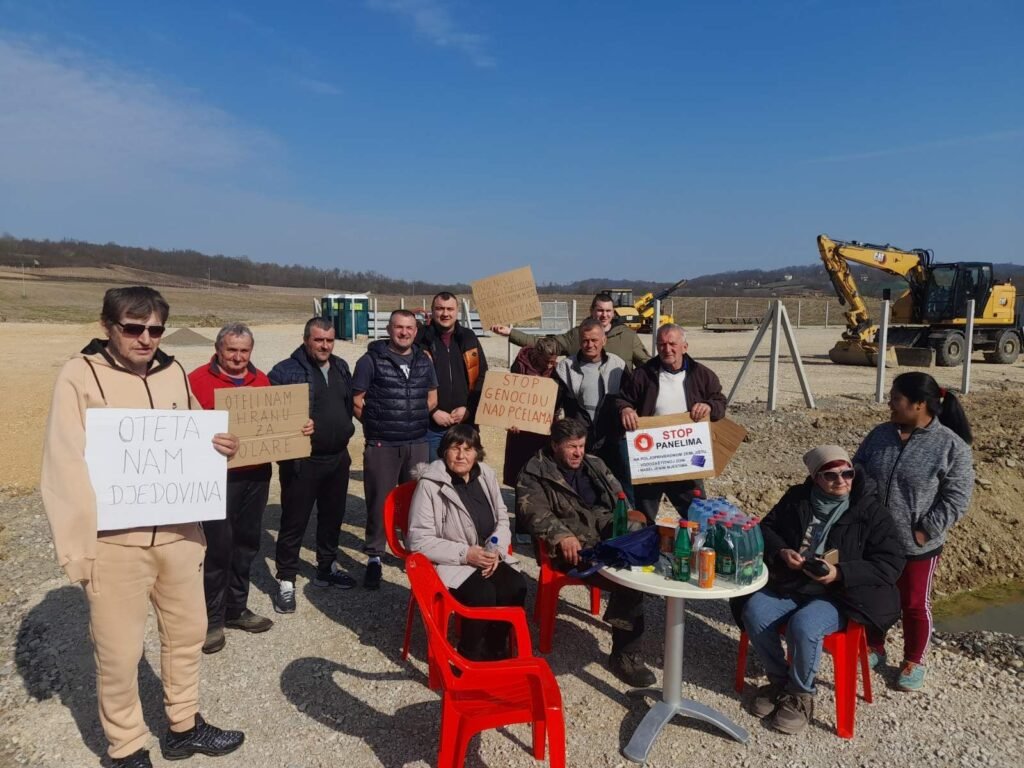
His experience echoes the stories of residents in Avtovac and Podnovlje. By their accounts, they were not informed in good time about projects that would change the land right around their homes. In Avtovac, Desko Mastilović reacted only when the company arrived on site and began building, while Podnovlje’s residents came face to face with the scale of the project when the works were already well advanced. In all three cases, people living next to planned or built plants say the information reached them only through the media, activists or the construction site itself, rather than through timely notice and dialogue with institutions.
“I found out from a journalist from the Direkt portal. I couldn’t believe it,” Radić recalls.
Residents then organised a petition. According to the initiative committee, around 5,800 people signed it. Radić insists on one point: it was a petition, not a referendum.
“Nevesinje has around ten thousand inhabitants, and 5,800 signed. We couldn’t even get round all the places,” he says. “People understood the problem, and the voice of the people must be heard.”
In early 2026, the Nevesinje Municipal Assembly rejected the spatial planning proposals for solar plants that were before its councillors at the time. The ruling parties and the opposition voted together.
Even so, activity did not stop entirely. During the year, surveyors appeared in the Kovačice area, and works and tree felling were later recorded. The Center for Environment requested an inspection. Residents kept warning that they did not know exactly what project was being prepared.
Republika Srpska’s Ministry of Energy and Mining has a different explanation. It says it acted lawfully when awarding concessions for projects in Nevesinje and Gacko, and that all the necessary opinions were positive at the time, including those of local communities.
In its response, the ministry says the problem arose only later, when local authorities changed their position under pressure from residents and stopped work on preparing the spatial planning documentation. Such a change, the ministry warns, could jeopardise the implementation of concession contracts and lead to litigation.
Minister Petar Đokić places much of the responsibility for choosing sites on local authorities.
“It is the municipalities that must say whether they are happy for an energy facility to be built at a particular site. When someone approaches us for a concession, we first seek the municipality’s opinion. If it is positive, we proceed; if it is negative, that is where it stops. From the municipalities that now say they have a problem, we previously received positive opinions from their official bodies,” Đokić says.
The ministry thus points to the local authorities’ positive opinions as proof that the procedure was followed. At the same time, Radić and other residents say they learned of the scale of the projects only from the media. Institutions were already giving their views on the sites at a time when the people who live and work on that land say they had not even been informed of the plans in good time.
Gacko: ten small plants in Avtovac, one of 200 megawatts at Stepen
For more than a year, Desko Mastilović of Avtovac near Gacko has been following a project taking shape right behind the houses in his neighbourhood.
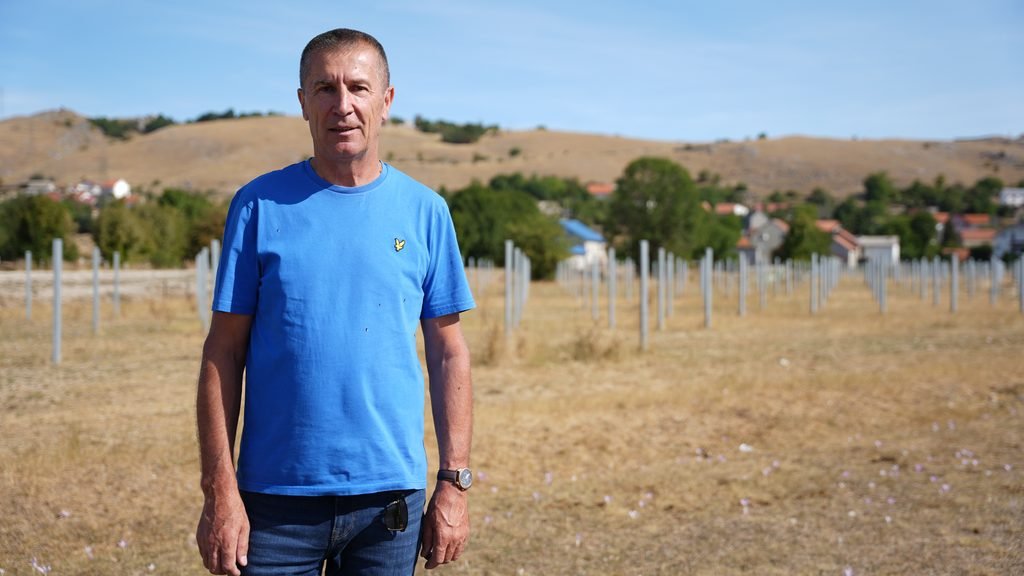
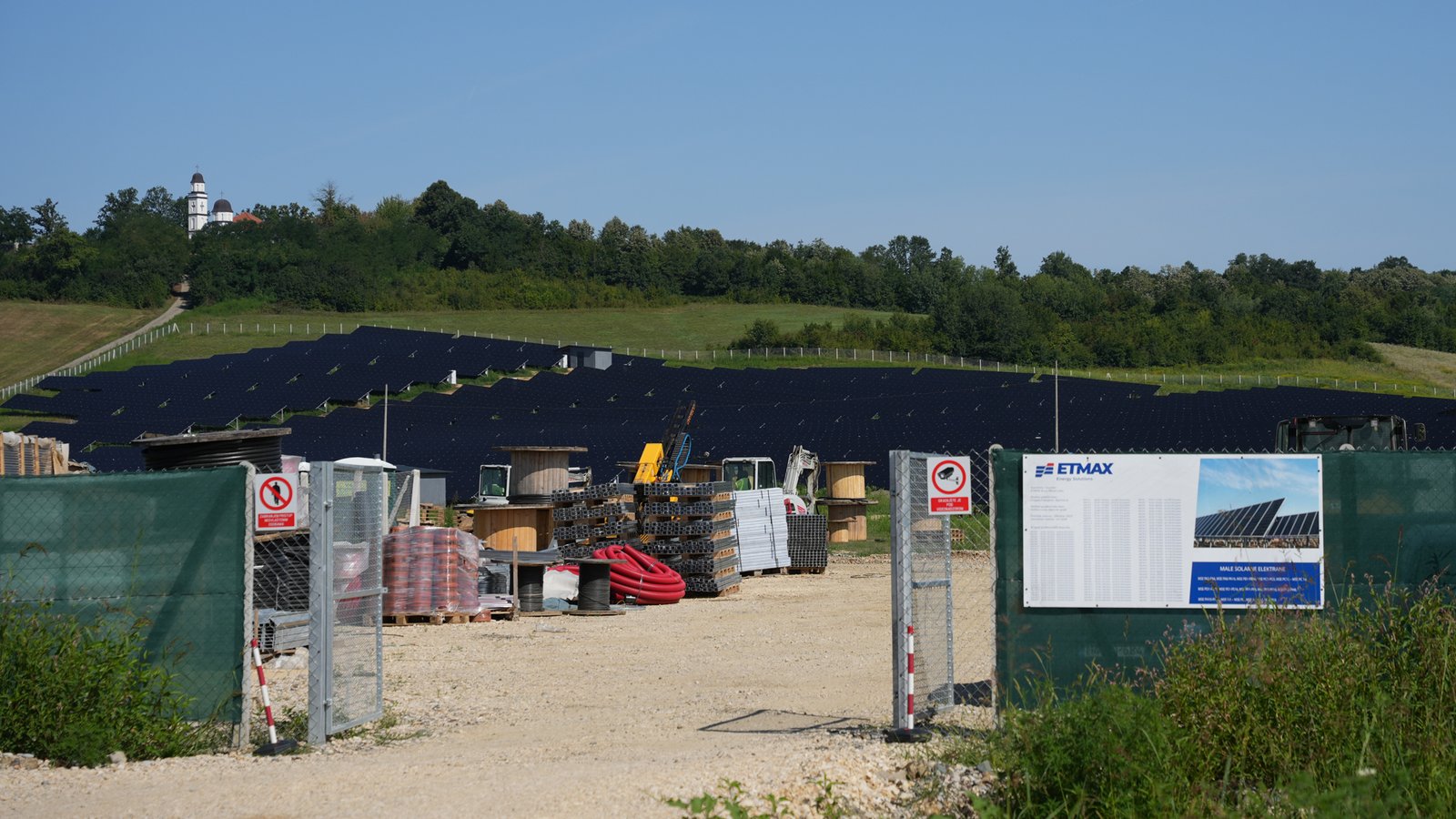
Here, too, the same company appears as in Podnovlje. The project involves around ten smaller solar plants linked to ETMAX. According to documentation and information published by the Direkt portal, ETMAX began works in Avtovac before obtaining a building permit, and only then started procedures to obtain the necessary site conditions and other approvals.
More than 40 people, many of them children, live in the six nearest houses, Mastilović says, and the primary school is around 200 metres away.
His main objection is not the size of any single plant, but the cumulative impact of all the installations.
“Perhaps one small solar power plant would not have a significant impact. But when you put ten of them together, you already have a megawatt and a half here,” Mastilović says. “In our view, these are not ten unrelated installations but one power plant split into several smaller ones through cables and metering points. And then each of them is treated differently from how the whole thing would be treated if it were considered as a single unit.”
Only a few kilometres away, a project of an entirely different scale is planned. SolarWin was granted a concession for the Gacko solar power plant: 200 MW on around 203.7 hectares of land in the Cernica and Stepen area. The project’s estimated value is around 168 million convertible marks (KM), and its planned annual output is 260 GWh.
Residents of Stepen and surrounding villages organised against the project. Around 1,700 citizens signed the initiative “Stop the construction of a solar power plant on agricultural land in the Stepen local community”, asking that the large solar project not be built on the pastures and land they use for farming and livestock.
On 24 March 2026, at a special thematic session, the Gacko Municipal Assembly unanimously adopted their initiative. Its conclusion was sent to the mayor and municipal departments, as well as to the Government of Republika Srpska, the relevant ministries and the Concessions Commission.
That did not, however, stop the procedure at the level of Republika Srpska. Just two days later, a government decision granting SolarWin the concession to build and operate the 200 MW plant came into force.
The concession did not mean construction could begin. The required spatial planning documentation had not been completed at local level and, according to the latest publicly available information from Direkt, from July 2026, no concession contract had yet been signed with SolarWin, even though the deadline for concluding it had already passed.
Food vs. solar
The debate over solar projects in Gacko and Nevesinje has not stopped at petitions and local assembly decisions. On 3 September 2026, Transparency International in BiH organised a public forum and debate in Gacko on the construction of solar power plants in the two municipalities. In the cinema hall of the Culture and Sports Centre, residents and experts discussed the consequences of large solar projects, the protection of agricultural land, and the benefits of electricity generation weighed against what the local community stands to lose.
One of the participants was Professor Marija Tasić, a full professor at the Faculty of Technology of the University of Niš. She warned that a farm field is not an empty space waiting for a new use. It already produces fodder, retains water, builds organic matter and provides income for people who make their living from agriculture.
“You will gain revenue in the energy sector, but you will take away revenue in the agricultural sector,” Tasić said.
That is why, in her view, the value of a future power plant should be judged not only in megawatts and electricity revenue, but also by the food production that disappears when agricultural land permanently changes its use.
“Energy has its alternatives, many alternatives, but this fertile soil does not. The question you should be asking is not how many kilowatts that solar panel will produce, but what food we will lose from that agricultural land,” Tasić said.
Investors propose the sites, the state assesses them later
In its response to us, Republika Srpska’s Ministry of Energy and Mining confirms something important for understanding the whole system. It conducts concession award procedures “acting on initiatives from interested bidders”, while the Government of Republika Srpska makes the final decision.
In other words, the initial idea for the location of a large project most often comes not from public authorities that have first decided where they want new energy generation, but from the investor.
Only after the investor’s initiative does the ministry seek opinions from other institutions: the Ministry of Agriculture, the ministry responsible for spatial planning, the institute for the protection of cultural, historical and natural heritage, the local authority and, where publicly owned land is involved, the public attorney’s office.
Economist and energy expert Damir Miljević sees this as one of the key problems.
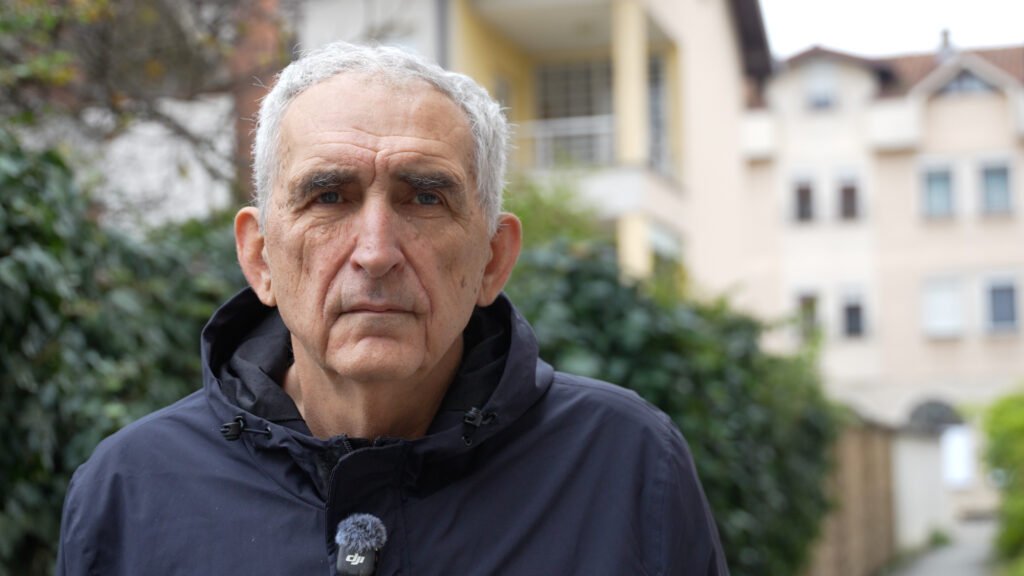
“The biggest problem is that the energy transition in Bosnia and Herzegovina is being led not by governments but by investors. Here, unsolicited bids for concessions are the main mechanism in use,” Miljević says.
Instead of such a system, he advocates public auctions, in which the state would set in advance how much new capacity it needs and under what conditions, and investors would then compete with their projects, sites and terms.
Economist Aziz Šunje believes one should go a step further and decide in advance where energy projects can be built at all.
“The state should, so to speak, lead the game,” Šunje says. “There should be a strategy that clearly identifies the sites and areas where solar plants can be built, how much energy can be produced at each of them and what economic benefit the local community gets from the project. Only then should talks with investors begin.”
In his view, agricultural land should not be used for large solar plants at all where lower-category land unsuitable for farming or forestry is available. Concession contracts, he believes, should also set out clear obligations for investors to remove and dispose of the equipment at the end of a plant’s working life.
That the problem is not limited to Republika Srpska is shown by an analysis by Transparency International Bosnia and Herzegovina. TI BiH reviewed seven cantonal concession laws in the Federation of BiH and found similar weaknesses: none clearly prescribes a procedure for establishing the public interest, while five allow concessions to be awarded after an unsolicited bid, without mandatory public tendering.
This shows that the model in which an investor initiates a project and institutions assess its public interest only afterwards is not the problem of one entity, but a much broader question of how concessions are awarded across Bosnia and Herzegovina.
Incentives for big investors, prosumers left waiting
Economist Damir Miljević believes the fundamental mistake was made long before the first disputes over arable fields ended up before courts and inspectorates.
In his reading, Bosnia and Herzegovina uncritically adopted a model developed for a differently structured European electricity market. In much of the European Union, households account for a smaller share of total consumption than in Bosnia and Herzegovina, which makes large commercial power plants a logical way to decarbonise industry. Bosnia and Herzegovina, Miljević believes, should have done much more, much earlier, to encourage citizens and businesses to produce energy on their own buildings.
“Generating electricity from rooftop solar plants, intended primarily for own consumption, is the fastest, cheapest and most socially and environmentally cost-effective way to decarbonise domestic consumption,” Miljević says. “It reduces the need for large investments in transmission capacity while preserving land.”
Such producers are called prosumers: households or businesses that are not only consumers of electricity, but produce part of the power they need themselves, most often with solar panels on their own roofs. The advantage, Miljević explains, is that electricity is produced exactly where it is consumed, without having to be carried to the consumer from a distant power plant.
According to his figures, Bosnia and Herzegovina lags far behind in developing this model. He says it has around 0.1 prosumers per 1,000 inhabitants, while Montenegro has almost 20 and Poland around 42 per 1,000 inhabitants.
Miljević also points to the speed of such a transition. A rooftop solar plant, he says, can be installed in two to three months, while building a large commercial solar plant takes around a year to a year and a half.
The development of large commercial solar plants, he believes, should have been left much more to the market, while public incentives should have been directed towards prosumers.
“Everything here is geared towards commercial investors, from the incentive system and concession policy to unsolicited bids. Instead of the state saying how much energy it needs and where it wants it produced, the investor proposes the project, the site and the timeline. Our energy transition is to a large extent being led by investors, not governments,” Miljević says.
His solution is not a ban on large solar plants. He proposes public auctions, guarantees through which investors would prove they genuinely intend to carry out the projects they have registered, stricter management of grid capacity and much stronger development of prosumers.
Bosnia and Herzegovina: 16,000 MW in applications, 630 MW connected
The gap between projects applied for and those actually connected in Bosnia and Herzegovina shows how much of the solar and wind boom is still only an investment intention.
Elektroprenos says it has received 313 applications to connect wind and photovoltaic power plants, with a total capacity of around 16,000 MW. So far, only 18 facilities, with a total capacity of 630 MW, have actually been connected.
Planning the grid as if every application would actually be realised would be “unrealistic” and would lead to an oversized network, Elektroprenos states openly.
NOSBiH’s plan warns of the other side of the problem. If large numbers of new solar and wind plants are connected without matching development of transmission capacity and balancing systems, serious consequences are possible, from congested lines to “potential system collapses”.
This is not a forecast that Bosnia and Herzegovina’s power system will collapse. But it is clearly a warning that generation from variable sources cannot grow independently of the grid that has to absorb that energy.
For every large project, Elektroprenos prepares a separate study of the technical solution for its connection. Only then can it be established whether the existing grid can take the plant, or whether new lines, substations and reconstruction are needed.
Željko Đurišić, a professor at the School of Electrical Engineering of the University of Belgrade and an expert on integrating renewables into power systems, believes the state and the transmission system operator should first determine how many new solar and wind plants the system can absorb, in which regions and over what period. Only then should the available capacity be allocated to investors through auctions.
“I believe such an approach would allow a controlled integration of renewable energy sources, while at the same time preserving the state’s interest in the use of the available solar and wind resources,” Đurišić said in a response for this investigation.
Through auctions, the state would then decide which projects get priority for connection.
“The power system cannot, in the foreseeable future, absorb all these sources,” Đurišić warns, which is why he believes a priority list of projects is needed.
Such a model would reverse the current order. Instead of investor applications piling up first and a way then being sought for the grid to absorb them, it would be decided in advance how much new capacity the system can handle and where it can be connected.
In Bosnia and Herzegovina, however, the key planning documents are still lagging behind. The country has no finally adopted National Energy and Climate Plan (NECP) to 2030, nor have the corresponding entity-level plans or a new energy strategy been adopted.
Republika Srpska’s 2024 programme for the use of renewable energy sources was therefore drawn up on the basis of a working version of the energy and climate plan and the estimates available at the time. Republika Srpska’s Ministry of Energy already expects to have to amend it once the final NECP is adopted.
While the strategic documents are still being drafted, solar projects, connection applications and land conversions have already moved far ahead. In other words, Bosnia and Herzegovina’s energy transition did not wait for the planning to be completed.
Where else solar can go
The ideas coming from Bosnia and Herzegovina, more planning and more generation for own consumption, match the alternatives proposed by experts in North Macedonia.
Protecting fields, they point out, can begin with the choice of site, before any conversion procedure has even been launched.
Nikolovska proposes giving priority to degraded and unused land, former industrial and mining zones, rooftops, car parks and already urbanised areas. She points to the map of suitable locations for renewable energy produced by Eko-svest, the Macedonian Academy of Sciences and Arts and The Nature Conservancy, which also takes natural values into account. In her view, that analysis should become a practical basis for planning new capacity.
“There is no need to sacrifice fertile land to develop solar energy when alternative locations exist,” Nikolovska says.
Trajkovski proposes steering investors towards such sites through tax relief and subsidies. At the same time, he would tighten control of land conversion through more frequent inspections and penalties that deter abuse.
Dimitrievski also sees an opportunity in agrivoltaics, where food and electricity are produced on the same land. He stresses that he is not against photovoltaic plants, but believes they should be built where they pose the least threat to food production.
The draft of the new law also covers agrivoltaics. The proposed Article 86 would require farming to remain the primary use, access for agricultural machinery to be preserved, and at least 70 per cent of the area to remain cultivable and functional. It also proposes an initial soil analysis, periodic agronomic reports and an obligation to return the land to a condition suitable for farming once the installation is removed.
To know whether protection works in practice, data are also needed. Every power plant should be linked to a specific plot, its previous use and class, the conversion decision and the permits issued. The gaps acknowledged by the ministries and the discrepancies found by auditors show why a shared register is part of a possible solution.
The consequences of losing fields, Dimitrievski warns, go beyond statistics on hectares. What is lost is the ability to produce food today, and the potential for greater self-sufficiency tomorrow.
“We should preserve agricultural land as a strategic resource and leave it to future generations too,” he says.
“We just need land”
When Veso Radić talks about land, he does not count it in megawatts.
He points to the plots now in production. He also points to large areas that, he says, farmers have tried for years, without success, to lease. Producers, he says, are ready to pay rent, invest in the land and use the existing irrigation systems.
He is not asking for Herzegovina to have no solar power plants.
“Let them build them where it is not agricultural land. Let us work here,” Radić says. “We asked to lease that land so we could produce. We have people, we have livestock, we have production and we have somewhere to sell some of it. We just need land.”
Behind him, Nevesinjsko Polje stretches between the mountains: a landscape that farmers and energy investors today see in completely different ways.
In power system documents, the name Nevesinje already stands beside hundreds of planned megawatts. In the fields of Pridvorci, for now, potatoes are still growing.

This investigation was supported by Journalismfund Europe.