
For the Western Balkans, this pattern feels familiar. In NarativAI’s investigation, “Rare Plant Species: Protected on Paper, Disappearing in Reality,” we documented how legally protected plant species continue to disappear from natural habitats, often unnoticed and rarely investigated. Protection exists in legislation, while enforcement on the ground remains weak or fragmented.
Author: NarativAI
When INTERPOL announced the results of Operation Thunder 2025 in December, global headlines focused almost exclusively on animals. Nearly 30,000 live specimens were seized worldwide in one of the largest coordinated actions against wildlife and forestry crime. But behind the animal-focused narrative lies a quieter finding: protected plants were also part of the seizures.
In its official summary, INTERPOL noted that “this record number of seizures included tens of thousands of protected animals and plants and tens of thousands of cubic metres of illegally logged timber, as well as more than 30 tonnes of species classified as endangered under the Convention on International Trade in Endangered Species of Wild Fauna and Flora (CITES).” While animals dominated public attention, plants were mentioned only in passing.
This imbalance is not accidental. Animals trigger emotion, images and outrage. Plants rarely do.Yet the inclusion of plants in a global law-enforcement operation confirms that illegal plant exploitation is treated as part of organised environmental crime, even if it remains largely invisible to the public. Seeds, live plants and plant products move through the same trafficking routes as animals, but without the same scrutiny.
The official breakdown published by INTERPOL shows how attention gravitates toward animals. Elephants, rhinoceroses, pangolins, primates, birds and reptiles dominate the figures, with tens of thousands of individual animals and animal parts seized during Operation Thunder 2025. These categories are visually foregrounded and numerically detailed, reinforcing the public perception that wildlife crime is primarily about animals.
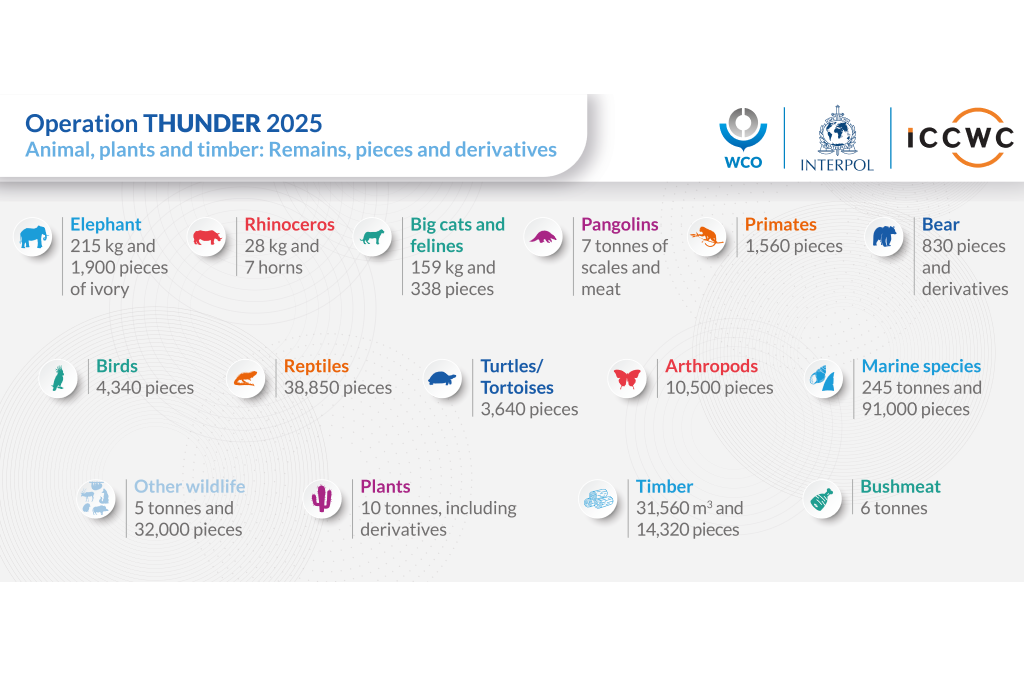
Yet the same data quietly records the seizure of 10 tonnes of plants, including derivatives — listed alongside timber, bushmeat and other wildlife products. Unlike animals, plants appear as a single aggregated category, without imagery or species-level detail. This contrast is telling. While animals are counted, named and visualised, plants are reduced to weight and grouped under derivatives, despite being formally recognised as part of wildlife and forestry crime. The imbalance mirrors what NarativAI documented on the ground: plants are legally protected, included in enforcement statistics, yet consistently sidelined — making their disappearance easier to overlook and harder to trace.
For the Western Balkans, this pattern feels familiar. In NarativAI’s investigation, “Rare Plant Species: Protected on Paper, Disappearing in Reality,” we documented how legally protected plant species continue to disappear from natural habitats, often unnoticed and rarely investigated. Protection exists in legislation, while enforcement on the ground remains weak or fragmented.
INTERPOL’s findings do not contradict this reality. They reinforce it. Seizures reflect intercepted cases, not the full scale of extraction, and show that plants are already being removed, traded and sold before authorities intervene. When attention focuses almost exclusively on animals, plant loss becomes easier to ignore.
The result is a paradox: plants are recognised by law, included in international operations, and protected on paper, yet they continue to vanish quietly. Without public visibility, monitoring and accountability, their disappearance rarely becomes a scandal.Animals may steal the spotlight, but plants are disappearing in the shadows.
🔗 Read the full investigation by NarativAI:
👉 https://narativai.org/rare-plant-species-protected-on-paper-disappearing-in-reality/
(This text was written and reviewed by the editor with support from artificial intelligence tools for language editing and stylistic refinement. More on how NarativAi uses AI — Link)